On Fact-checking RAG Outputs
Overview
In this article, we explore the challenges and methods of fact-checking RAG
(Retrieval-Augmented-Generation) output.
We begin with a philosophical rant about what exactly a fact is. And why I think knowledge is better represented in an “index” (encyclopedia) rather than in a “knowledge graph”.
Following that, we go into practical experiments, including:
- Implementing a fact extractor using “GPT-4o-mini”.
- Utilizing “DeBERTa” for detecting contradictions between two sentences.
- Building a fact-checker pipeline.
- Finally, we test these tools in a controlled environment using a single-document Retrieval-Augmented Generation (RAG) setup to detect if the RAG system has given us false information.
The code accompanying this article can be found here on Github.
The interestingly lame question of what a fact is
I’m not a cynic (maybe a little), sure, but things do happen for a fact. It’s just that our narrative of them is entirely relative. We can not check if something happened or not for real. What we can do is check one narrative against another. And hope that the narrative we consider as premise is a fact.
Sure, simple sentences are easy to, easy enough to comprehend. “Ahmed went to the doctor” is an easy one.
But let’s consider “Ahmed went eagerly to the doctor”. Now that’s very difficult. What does eagerly mean? Does it match with the other sentence “Ahmed wanted to go to the doctor”?
It’s tricky!
Let’s consider another sentence describing a scientific fact that says “Plants start photosynthesis early in the morning”. Now does that mean that they start at 8:00? 6:00?
How would this sentence be matched against the sentence “Plants start photosynthesis in the morning”. One of them is more “correct” than the other.
Knowledge as a graph
Taking the simple sentence of “Plants do photosynthesis”, we can represent it as a graph. With “Plants” as a node, “Photosynthesis” as another node and they are connected through an edge with a label “do” or the whole sentence can be the label.
This constructs a knowledge graph.
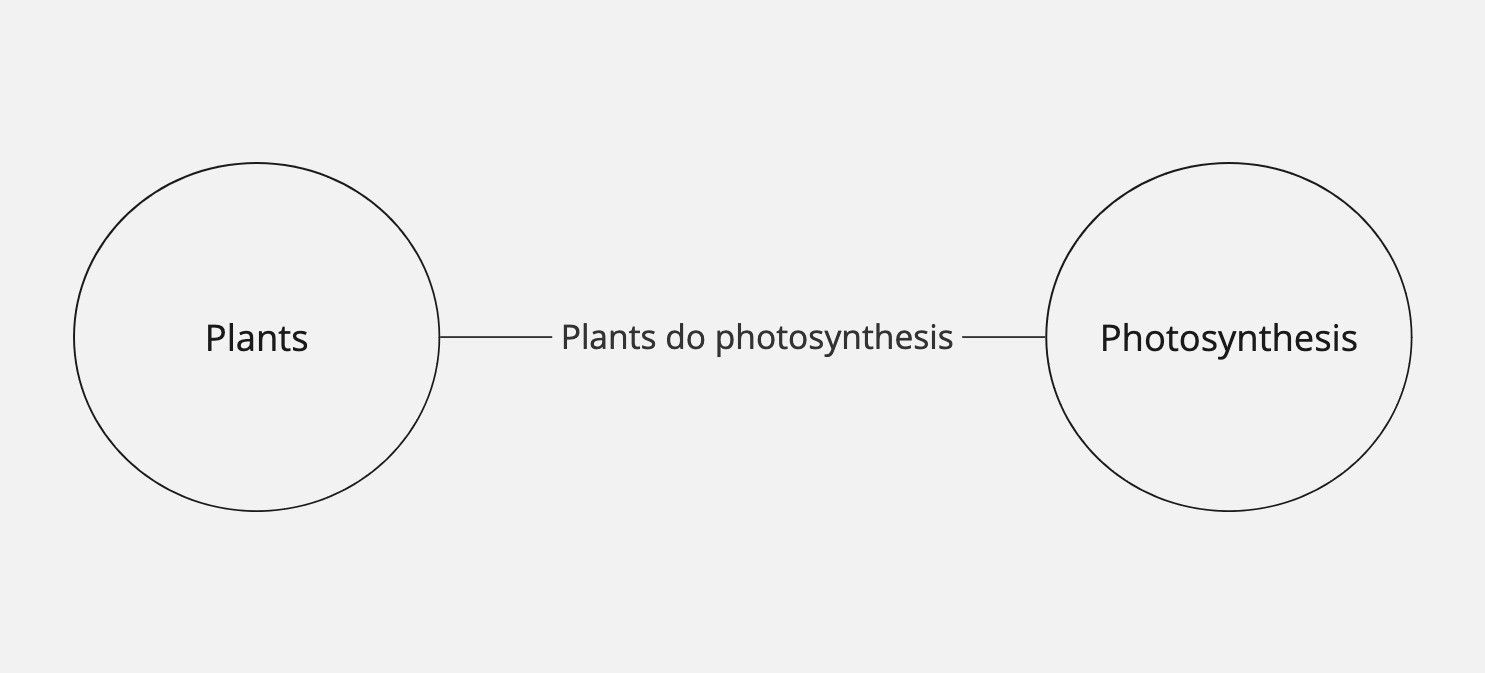
Very simple knowledge graph
But when sentences get complex, the graphs get complex and putting knowledge into the graph also gets complex. Again what about “Plants do photosynthesis early in the morning”.
Encyclopedias (Indexes) are simpler
What has worked well so far to describe knowledge is simple text in encyclopedias. Plain old written knowledge in sentences using any language. And we take the entities from each piece of text and we put it in an index for easier lookup.
Extracting facts from text
LLMs can do a relatively good job of extracting the mentioned entities and their references in a piece of text. They can basically build an index. If we consider this text to be a true “Premise”, then we can consider the index of entities and their represented sentences as an index of entities and facts about those entities.
Now let’s build a simple fact extractor using an LLM.
We define an abstract Python class called Extractor
class _Extractor(ABC, Generic[T]):
    """ Extractor is a base class to extract info from a text using an LLM """
    # _model_name
    def set_model_name(self, model_name:str = "ollama3.2"):
        self._model_name = model_name

    def get_model_name(self):
        return self._model_name

    # _llm
    def set_llm(self, llm: Runnable):
        self._llm = llm

    def get_llm(self):
        return self._llm

    # _base_prompt
    def set_base_prompt(self, base_prompt: str):
        self._base_prompt = base_prompt

    def get_base_prompt(self):
        return self._base_prompt

    @abstractmethod
    def extract(self, paragraph: str) -> T | None:
        pass
Extractor class is a base class to extract info from a text using an LLM
And we implement it allowing using either llama3.2 or gpt-4o-mini. I observed that for this task, llama3.2 failed miserably.
extract_facts_prompt = """
    Role: You'e an assistant for extracting entities and facts about thos intenties from a piece of text.
    Given a paragraph, extract all meaningful entities in it and the facts mentioned in the text about those entities.

    Input: {input}
"""

class FactExtractor(_Extractor[Facts]):
    def __init__(self, model_name="llama3.2"):
        self.set_model_name(model_name)
        self.set_base_prompt(extract_facts_prompt)
        if model_name == LLAMA_MODEL:
            self.set_llm(langchain_ollama.ChatOllama(model=model_name).with_structured_output(Facts))
        elif model_name == OPEN_AI_MODEL:
            if not os.environ.get("OPENAI_API_KEY"):
                os.environ["OPENAI_API_KEY"] = getpass.getpass("Enter API key for OpenAI: ")
            self.set_llm(langchain_openai.ChatOpenAI(model=model_name).with_structured_output(Facts))

    def extract(self, paragraph: str) -> Facts | None:
        """ Extracts the information from a given text and formats the output based on the return type """
        try:
            prompt = self.get_base_prompt().format(input=paragraph)
            return self.get_llm().invoke(prompt)
        except Exception as e:
            print(f"error extracting facts: {e}")
            return None
Fact extractor class
And the return type of this extract method is this special type
class Entity(BaseModel):
    entity: str = Field(description="An entity")
    sentences: list[str] = Field(description="Sentences that mention the entity")

class Facts(BaseModel):
    entities: list[Entity] = Field()

    def to_dict(self) -> dict[str, list[str]]:
        res = {}
        for entity in self.entities:
            res[entity.entity] = entity.sentences
        return res

    def lookup_similar(self, key: str) -> list[str]:
        index = self.to_dict()
        res: list[str] = [];
        parts = key.split(" ")
        parts += key.split("-")
        parts += key.split("_")
        parts += key.split(",")
        for part in parts:
            for key in index.keys():
                if part in key:
                    res += index[key]
        return res
Facts type class
The above fact extractor can extract entities and facts from a paragraph.
For example if we give it an input of “Go supports generics”, it will give us something like this:
Go           ---> ["Go supports generics"]
generics ---> ["Go supports generics"]
Detecting contradiction
Now when it comes to fact-checking, there is no general absolute fact checking. We can only compare a hypothesis against a premise.
Consider this:
Hypothesis: “Go supports generics”.
Premise: “Go supports generics as of version go1.18”.
They do not contradict, but they don’t match 100%. Therefore, this fact checking should not return a boolean. It should give us a score and a classification. A good job for an encoder only transformer models which can do a good job of understanding text and classifying it.
I’ll choose DeBERTa for detecting contradiction.
How does it differ from an LLM?
In short, LLMs excel in text generation and general-purpose tasks, while BERT and DeBERTa specialize in text comprehension and specific NLP applications.
An observation with BERT and DeBERTA
I observed through experimenting that passing two sentences to DeBERTa is far more accurate in detecting contradiction than passing a paragraph as the premise and a sentence or another paragraph as a hypothesis.
Now let’s build a fact-checker with DeBERTa
class Checker():
    labels: dict[int, str]
    model: PreTrainedModel
    tokenizer: PreTrainedTokenizer

    def __init__(self, model_name="microsoft/deberta-large-mnli"):
        self.tokenizer = AutoTokenizer.from_pretrained(model_name)
        self.model = AutoModelForSequenceClassification.from_pretrained(model_name)
        self.labels = {0: "contradiction", 1: "neutral", 2:"entailment"}

    def check_contradiction(self, premise: str, hypothesis: str):
        # Tokenize the inputs
        inputs = self.tokenizer(premise, hypothesis, return_tensors="pt")

        # Get model output
        outputs = self.model(**inputs)
        logits = outputs.logits

        # Apply softmax to the logits to get probabilies
        probabilities = torch.softmax(logits, dim=-1)

        # Get the index of the max probability
        predicted_index = int(torch.argmax(probabilities).item())
        predicted_label = self.labels[predicted_index]

        # Get the value of the max probability
        confidence = probabilities.max().item()

        return predicted_label, confidence
Fact checker with DeBERTa
Our fact checker class returns a score and a classification of either a
- Contradiction.
- Entailment.
- Neutral.
Now let’s utilize those 2 components into a RAG system to fact-check the RAG system LLM output against the context to decrease the likelihood of hallucination.
Building a test hallucinating RAG
We use langchain graph as we did in previous articles to spin up a simple RAG system. But we hijack the LLM answer with something false. And see how our fact-checker does.
Here we initialize the LLM, fact-checker, fact-extractor and the RAG state. We also hard code one blog post to use in our retriever.
blog_post = """
        The Go 1.18 release adds a major new language feature: support for generic programming. In this article I’m not going to describe what generics are nor how to use them. This article is about when to use generics in Go code, and when not to use them.

        To be clear, I’ll provide general guidelines, not hard and fast rules. Use your own judgement. But if you aren’t sure, I recommend using the guidelines discussed here.

        Write code

        Let’s start with a general guideline for programming Go: write Go programs by writing code, not by defining types. When it comes to generics, if you start writing your program by defining type parameter constraints, you are probably on the wrong path. Start by writing functions. It’s easy to add type parameters later when it’s clear that they will be useful.
        When are type parameters useful?

        That said, let’s look at cases for which type parameters can be useful.
        When using language-defined container types

        One case is when writing functions that operate on the special container types that are defined by the language: slices, maps, and channels. If a function has parameters with those types, and the function code doesn’t make any particular assumptions about the element types, then it may be useful to use a type parameter.
    """

def init_llm():
    global llm
    llm = ChatOpenAI(model="gpt-4o-mini", temperature=0)

def init_checker():
    global fact_checker
    fact_checker = fc.Checker()

def init_extractor():
    global fact_extractor
    fact_extractor = extract.FactExtractor("gpt-4o-mini")

class State(TypedDict):
    question: str
    context: str
    answer: str
Rag initialization
We define a fake retriever to use only this blog post as context. Also, we hijack the generate function to return something not correct.
def retrieve(state: State):
    _ = state # We're not using the state here
    # ... Fake document retrival
    retrieved_doc = blog_post
    return {"context": retrieved_doc}

def generate(state: State):
    rag_prompt = """
    You are an assistant for question-answering tasks. Use the following pieces of retrieved context to answer the question. If the context doesn't provide an answer, just say that you don't know and nothing more and never leak the context or what topics it covers.

    Question: {question}

    Context: {context}

    Answer:
    """
    try:
        messages = rag_prompt.format(question = state["question"], context= state["context"])
        response = llm.invoke(messages)
        # return {"answer": response.content}
        return {"answer": "Yes, Go supports generics as of the Go 1.13 release."}
    except Exception as e:
        print(f"error generating response form LLM: {e}")
        return {"answer": "I don't know how to answer this question"}
Hijacking the retrieve and generate functions
Then we define a fact checking step to go over the facts in the answer and compare them with the facts found in the context.
It’s probably a good idea to do this fact extraction operation on the documents while we load them into the stores. We should avoid extracting facts from them on every run.
def fact_check(state: State):
    facts_in_context = fact_extractor.extract(state["context"])
    if facts_in_context is None:
        print("Warning: Could not check RAG context for contradictions")
        return
    facts_in_answer = fact_extractor.extract(state["answer"])
    if facts_in_answer is None:
        print("Warning: Could not check RAG answer for contradictions")
        return

    contradictions = 0
    checked_hypothesis = {}
    for answer_entity, hypotheses in facts_in_answer.to_dict().items():
        for premise in facts_in_context.lookup_similar(answer_entity):
            for hypothesis in hypotheses:
                if hypothesis in checked_hypothesis:
                    continue
                checked_hypothesis[hypothesis] = {}
                (check_result, score) = fact_checker.check_contradiction(premise, hypothesis)
                if check_result == "contradiction" and score > 0.5:
                    print(f"\n Found contradiction in answer with known context.\n Premise: {premise} \n Hypothesis: {hypothesis}")
                    contradictions += 1

    if contradictions == 0:
        print("Fact checker validated RAG answer and found no contradictions.")
Fact checking logic
Next we glue it all together with a main function and an output function to print the output
def output(state: State):
    print(state["answer"])

def main():
    init_llm()
    init_extractor()
    init_checker()
    graph_builder = StateGraph(State).add_sequence([retrieve, generate, output, fact_check])
    graph_builder.add_edge(START, "retrieve")
    graph = graph_builder.compile()

    graph.invoke({"question": "Does Go support generics"})

if __name__ == "__main__":
    main()
Main function gluing all of it together
And we run it

Output of fact-checking false RAG output
Voile!